

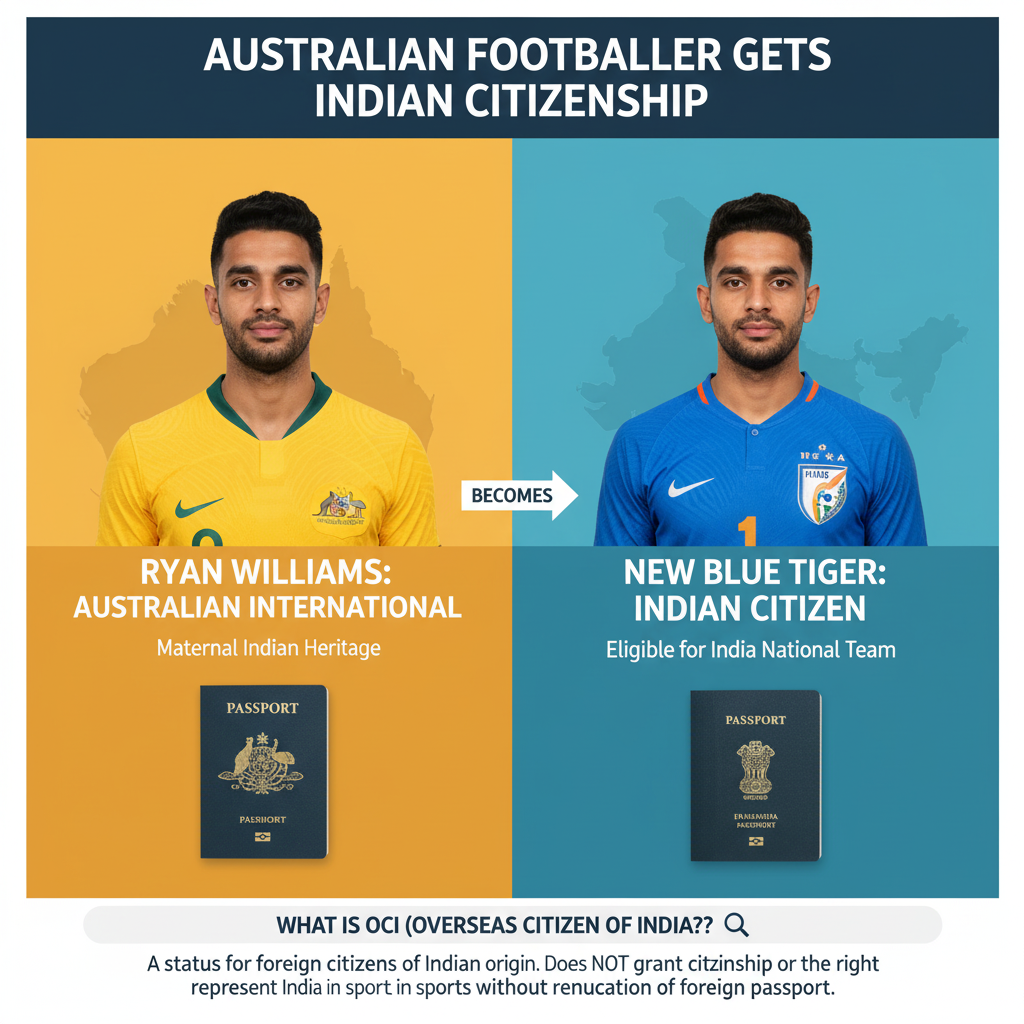
Ryan Williams Indian Citizenship : In a moment that was both deeply personal and politically charged, former Australian international winger Ryan Williams officially received his Indian Passport, handed over by the legend Sunil Chhetri. Williams, who has deep Anglo-Indian roots in Mumbai, became only the second professional footballer after Izumi Arata to voluntarily renounce foreign citizenship to play for the Blue Tigers.
On the one hand, this is a massive win for the Indian National Team. On the other, it exposes a bureaucratic hurdle that continues to cost Indian football hundreds of millions of dollars in inaccessible global talent.
The fundamental question is: Now that Williams has proven the commitment of the Indian diaspora by making this sacrifice, will his exceptional case finally force the government to create a sustainable policy for OCI Players in Indian Football?
That is a great strategic decision. Focusing the article on explaining the OCI rule through Ryan Williams’s personal journey will make a complex legal issue accessible, emotional, and highly relevant.
What is OCI, and Why Isn’t It Enough for Sport?
The term Overseas Citizen of India (OCI) refers to a person of Indian origin who is currently a foreign national. The OCI card, often called “lifelong visa,” grants holders certain privileges, but critically, it does not grant citizenship.
Here is a breakdown of what OCI provides and, more importantly, what it restricts in the context of international sports:
OCI Privileges
- Visa-Free Entry: OCI holders can travel to and live in India indefinitely without a visa.
- Economic Parity: They can buy non-agricultural property and pursue careers in the private sector.
- Educational Benefits: They are on par with Non-Resident Indians (NRIs) for education in India.
OCI Restrictions
- No Political Rights: OCI holders cannot vote, run for office, or hold government employment.
- No Indian Passport: They remain foreign nationals and cannot hold an Indian passport.
- Crucially, for Athletes: They cannot represent India in international sports.
The Ministry of Youth Affairs and Sports (MYAS) mandate, enforced since 2008, states that only holders of a valid Indian passport can represent the country at the international level. Since the OCI is a foreign national status, it falls short of this requirement.
For players like Williams, who was technically an OCI-eligible person through his mother’s lineage, the OCI card was a good start, but it was the last step, not the final key, to playing for the Blue Tigers.
The Legal Hurdle: Why Williams Had to Choose
Williams’ journey was not a simple paperwork exercise; it was a demonstration of dedication born from a legal anomaly.
India’s citizenship laws do not allow dual citizenship. This means that any Person of Indian Origin (PIO) or Overseas Citizen of India (OCI) holding a foreign passport must irrevocably surrender their original nationality to obtain an Indian passport and represent the country in sports.
This single piece of legislation acts as a permanent wall, blocking top-tier talent like Scotland’s Yan Dhanda, England’s Dilan Markanday, and a dozen others who hold high market value and play in competitive European leagues. Asking a professional athlete in their prime to give up their passport—which is tied to their career mobility, health insurance, family status, and post-football life—is a sacrifice few are willing to make.
Williams made that sacrifice, driven by a deep family history that includes his maternal grandfather, Lincoln Grostate, who played for Bombay in the Santosh Trophy in the 1950s. While a moving story of a “homecoming,” this process is simply not scalable.
📈 The Tactical & Financial Cost of Inflexibility
The arrival of Ryan Williams offers an immediate, quality solution to one of the biggest tactical deficiencies of the Indian National Team: a lack of pace, delivery, and goal threat from the wide areas. His link-up play with club teammate Chhetri at Bengaluru FC has already been outstanding, and he is expected to debut soon in the AFC Asian Cup qualifiers.
However, Williams is 32 years old. While he brings ready-made quality, the years of development that could have been provided by a constant flow of Indian-origin talent—especially in the crucial decade leading up to the 2026 World Cup and 2027 Asian Cup campaigns—are lost.
The Missing Millions
If India were to follow the model of countries like Ireland, Turkey, or Algeria—who successfully leverage their diaspora by allowing some form of dual-national representation—the value addition would be astronomical. The collective market value of the dozen or so quality Indian-origin players currently inaccessible is conservatively estimated to be in the tens of millions of dollars, with their impact on India’s FIFA ranking being priceless.
This is the “$1.3 Billion Question”: not just the market value of the players, but the potential economic and sporting value of having a stronger, globally competitive national team.
🚪 A Crack in the Door?
The good news is that Williams’ successful naturalisation was not an accident. AIFF President Kalyan Chaubey confirmed that the Sports Ministry and other government agencies fast-tracked the process, which usually takes years, following a personal conversation initiated by Sunil Chhetri.
This political will signals a huge shift in attitude.
However, relying on ministerial intervention for every talented individual is a poor substitute for a sound national policy. Williams’ case must not be viewed as the end of the debate, but as the final, dramatic proof that a systemic change is necessary.
The only way to tap into the global Indian talent pool sustainably is to formalize a pathway. Whether that means:
- Naturalisation by Exception: Creating a specific amendment to the Citizenship Act for elite athletes.
- A Special OCI Dispensation: Allowing OCI cardholders to represent India internationally via a sports-specific declaration.
Whatever the legal route, the time for inertia is over. Ryan Williams’ Indian Citizenship has made the debate impossible to ignore. His story is a powerful testament to heritage and commitment, but its true legacy will be measured by whether it finally opens the doors for the countless other Indian-origin players waiting for the chance to wear the Blue Tigers’ jersey.